CRA Instalment Interest Explained: Why You’re Being Charged and How to Avoid It
Rocket Accounting
I started Rocket Accounting in 2017 to give small business owners a better chance at success. Running a small business is tough, and not all entrepreneurs get the support they need.
CRA Instalment Interest Explained: Why You’re Being Charged and How to Avoid It
Have you ever paid your entire tax bill by the deadline and then received a notice from the Canada Revenue Agency showing an interest charge?
One possible reason is CRA instalment interest.
CRA instalment interest can apply when you’re required to make tax instalments but don’t make them, make them late, or pay less than required. This can happen even if you eventually pay your remaining tax balance by its deadline because some of your tax was supposed to have been paid earlier.
This commonly catches incorporated business owners off guard, particularly those receiving dividends or earning income where little or no tax is withheld throughout the year.
Here’s how CRA instalment interest works and what you can do to avoid it.
What Is CRA Instalment Interest?
Canada’s tax system generally requires income tax to be paid throughout the year rather than entirely at tax time.
For an employee, this happens automatically. Your employer deducts income tax from your paycheque and remits it to CRA throughout the year.
But many other types of income don’t have sufficient tax withheld when they’re received.
Examples can include:
Dividends from your corporation
Self-employment income
Rental income
Investment income
Other income where insufficient tax is withheld
Corporations can also be required to make corporate income tax instalments throughout their fiscal year.
If you’re required to make instalments and those payments are late or insufficient, CRA may charge instalment interest.
Why Does CRA Require Tax Instalments?
Think about someone earning a $100,000 salary.
They don’t normally receive the entire $100,000 without any income tax deducted and then pay all their tax the following April. Their employer deducts tax throughout the year.
Instalments create a similar system for taxpayers who don’t have enough tax withheld at source.
Instead of waiting until the following year to collect the entire tax liability, CRA may require you to prepay your expected taxes throughout the year.
This applies separately to individuals and corporations, depending on their circumstances.
Personal Tax Instalments
Personal tax instalments commonly affect people such as:
Incorporated business owners receiving dividends
Self-employed individuals
Landlords
Investors
Individuals with multiple sources of income
Anyone who regularly has a significant personal tax balance owing
For most individuals outside Quebec, CRA generally looks at whether your net tax owing is more than $3,000 for the current year and either of the two preceding years when determining whether instalments are required. Different rules and thresholds can apply in certain circumstances, including Quebec.
CRA may send an instalment reminder showing suggested payments.
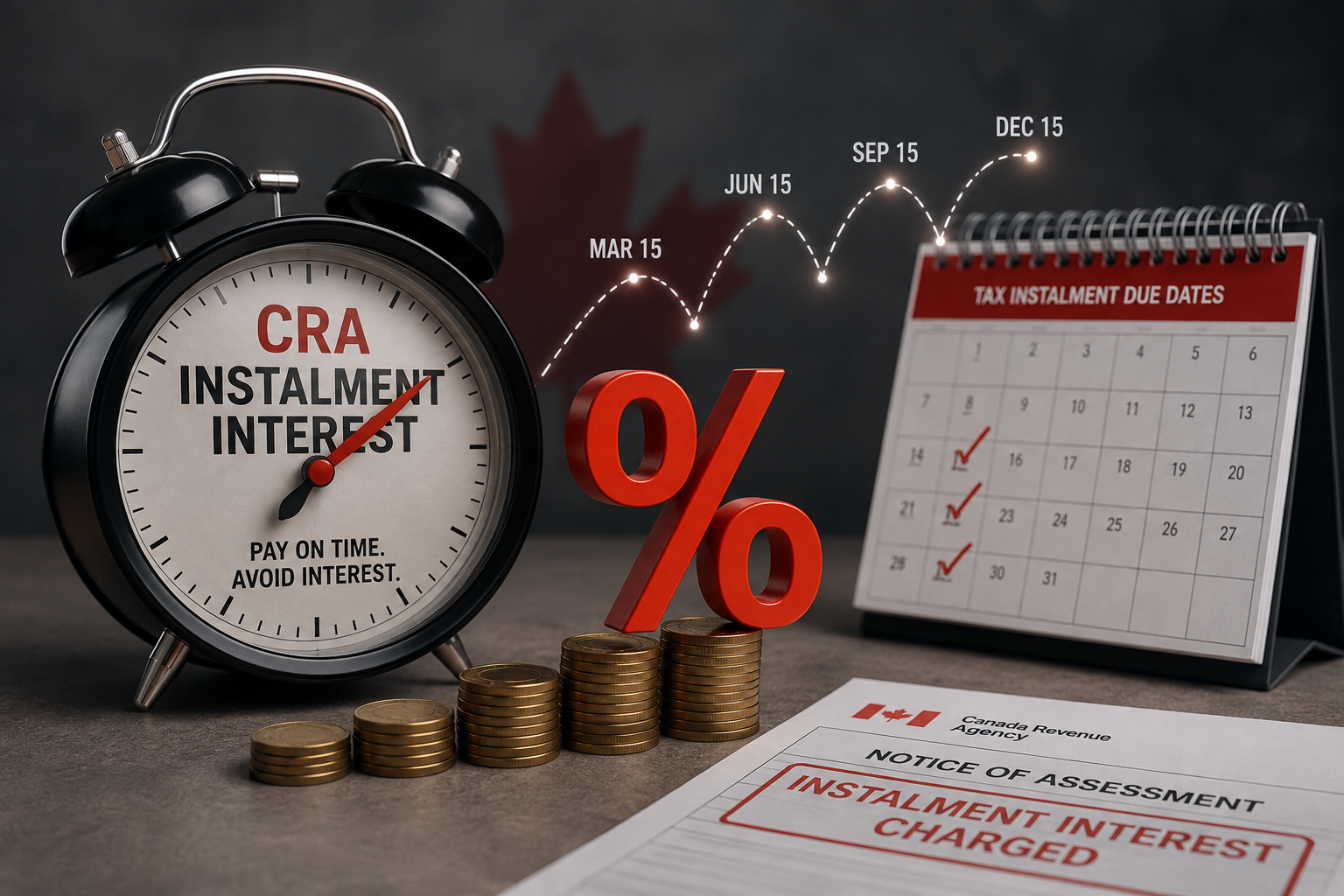
For most individuals required to pay instalments, the regular instalment due dates are:
March 15
June 15
September 15
December 15
The important point is that these payments occur during the tax year, not when you file your tax return the following spring.
A Simple Personal Tax Example
Let’s say you’re an incorporated business owner and you pay yourself primarily through dividends.
Because income tax generally isn’t withheld when your corporation pays you a dividend, you could end up with a significant personal tax liability.
Suppose your eventual personal tax bill is $30,000.
You might think:
“No problem. I’ll pay the $30,000 when my taxes are due.”
And you pay the entire balance by the applicable balance-due deadline.
However, if you were required to make instalments during the previous year and didn’t make them, CRA may still charge you instalment interest.
Why?
Because although your final balance may have been paid on time, some of that $30,000 was supposed to have been paid earlier through instalments.
That’s the distinction that causes a lot of confusion.
Corporate Tax Instalments
Corporations can also be required to make income tax instalments.
This is particularly important for growing businesses because many owners assume they’ll simply prepare the corporate tax return after year-end, determine the tax owing, and then pay CRA.
Depending on the corporation’s circumstances, that’s not necessarily how the payment schedule works.
Corporations generally make income tax instalments monthly when instalments are required.
Certain qualifying Canadian-controlled private corporations may be eligible to make quarterly instalments instead.
This is separate from the deadline for filing the corporation’s T2 corporate income tax return.
In other words, business owners need to distinguish between:
When the corporate tax return has to be filed
and
When the corporation’s income tax has to be paid.
They aren’t necessarily the same date.
Why Am I Being Charged Interest If I Paid My Taxes on Time?
This is probably the most important part of the article.
There is a difference between balance-due interest and instalment interest.
Balance-due interest can arise when you don’t pay your final tax balance by the applicable payment deadline.
Instalment interest can arise because required instalment payments weren’t made in the correct amounts or at the required times during the year.
So it is possible to pay your remaining tax balance by its deadline and still have instalment interest.
The question isn’t simply:
“Did I eventually pay CRA?”
It’s also:
“Was I required to pay some of this tax earlier?”
How Does CRA Calculate Instalment Interest?
CRA calculates instalment interest based on factors including:
The instalment amount that should have been paid
The amount you actually paid
When the payment was made
The applicable CRA prescribed interest rate
For individuals, CRA generally charges instalment interest at its prescribed rate, compounded daily. Prescribed rates can change quarterly.
There can also be an instalment penalty when instalment interest becomes sufficiently large.
The exact calculation can therefore vary considerably depending on the taxpayer’s situation.
From a planning perspective, the lesson is much simpler:
If you’re required to make tax instalments, paying the correct amounts on time can prevent unnecessary interest and penalties.
How Can You Avoid CRA Instalment Interest?
There are several ways to approach your instalments.
Pay the Required Instalments on Time
If CRA has provided you with an instalment schedule and it reasonably reflects your current circumstances, the simplest approach may be to make the required payments by their due dates.
This removes much of the uncertainty.
For corporations, don’t rely on receiving a reminder before taking action. Corporate instalment requirements should be monitored as part of the company’s tax planning.
Estimate Your Current-Year Tax Liability
Sometimes historical results aren’t a good reflection of what’s happening this year.
For example, perhaps:
Your income has decreased significantly
Your corporation is less profitable
You’re taking fewer dividends
Your sources of income have changed
Depending on your circumstances, instalments can potentially be calculated using an alternative permitted method based on current-year or prior-year information.
However, there’s a trade-off.
If you estimate your tax liability too low and consequently underpay your required instalments, CRA may charge instalment interest.
This is one area where working with your accountant throughout the year can be useful.
Include Taxes in Your Cash-Flow Planning
One of the biggest mistakes business owners make is treating every dollar in the bank account as available cash.
Some of that money may effectively be earmarked for:
Corporate income tax
Personal income tax
GST/HST
PST
Payroll remittances
Tax instalments
A better approach is to forecast these obligations throughout the year.
That turns taxes into planned cash outflows rather than unexpected emergencies.
Should You Pay More Than CRA Is Asking For?
Not necessarily.
The objective isn’t to send CRA as much money as possible.
Your business may have better uses for its working capital.
The objective is to make appropriate instalment payments while avoiding unnecessary interest and maintaining sufficient cash inside the business.
That’s where proactive tax planning becomes valuable.
If profits have increased significantly, you may need to increase the amount you’re setting aside.
If profits have fallen, blindly using an amount based on a stronger historical year may result in paying more tax in advance than necessary.
The appropriate strategy depends on your circumstances.
The Bigger Problem: Only Thinking About Taxes Once a Year
Instalment interest is often a symptom of a larger problem.
If the only time you look at your taxes is when your accountant prepares the return, you’re always looking backward.
By then:
The income has already been earned
Dividends may already have been paid
Instalment deadlines may have passed
Major business decisions have already been made
The tax liability already exists
For incorporated business owners, tax planning should ideally happen during the year.
You should have some idea of:
How profitable the corporation is becoming
Your expected corporate tax liability
How much you’re paying yourself
Your expected personal tax liability
Whether instalments are required
How much cash should be reserved for taxes
This makes tax season considerably more predictable.
Frequently Asked Questions
About CRA Instalment Interest
Can CRA charge instalment interest even if I paid my taxes by the deadline?
Yes. Paying your remaining tax balance by its deadline and making required instalments during the year are separate obligations. If required instalments were late or insufficient, instalment interest may still apply.
Why did CRA start asking me for instalments?
This often happens when you have enough tax owing that isn’t being withheld at source. This can occur with dividends, self-employment income, rental income, investment income and other sources.
Do corporations have to make tax instalments?
Many corporations do. Corporations generally make monthly instalments when required, although certain qualifying CCPCs may be eligible for quarterly instalments.
Does CRA send corporations instalment reminders?
Corporations are generally responsible for determining their own instalment requirements and payments rather than relying on CRA to send an instalment reminder.
Can I pay less than CRA’s suggested personal instalments?
Depending on your circumstances, there are different permitted methods for calculating instalments. However, if you calculate based on your expected current-year tax and underestimate the amount required, you could be charged instalment interest.
Final Thoughts
CRA instalment interest doesn’t necessarily mean you filed your tax return late or failed to pay your final tax balance by its deadline.
It can simply mean that CRA expected you to make tax payments throughout the year and those payments weren’t made in the required amounts or at the required times.
The best way to avoid surprises is to understand your instalment requirements, monitor your expected tax liability throughout the year, and incorporate taxes into your cash-flow planning.
If you’re an incorporated business owner and you’re regularly surprised by your tax bill—or you’re unsure how much you should be paying CRA throughout the year—Rocket Accounting can help. Book a Call
We work with Canadian business owners on corporate tax, accounting and proactive tax planning so that tax obligations can be addressed before deadlines have already passed.
Your construction company made a healthy profit last year. Your income statement looks good. Your accountant tells you the business is profitable. So why does it feel like there’s never enough money in the bank? This is one of the most common sources of confusion for construction business owners. The
CRA Instalment Interest Explained: Why You’re Being Charged and How to Avoid It Have you ever paid your entire tax bill by the deadline and then received a notice from the Canada Revenue Agency showing an interest charge? One possible reason is CRA instalment interest. CRA instalment interest can apply
Learn 7 overlooked tax write offs for small businesses in Canada. Burnaby’s small business tax accountants explain the most common items you can claim on taxes to lower your tax bill.