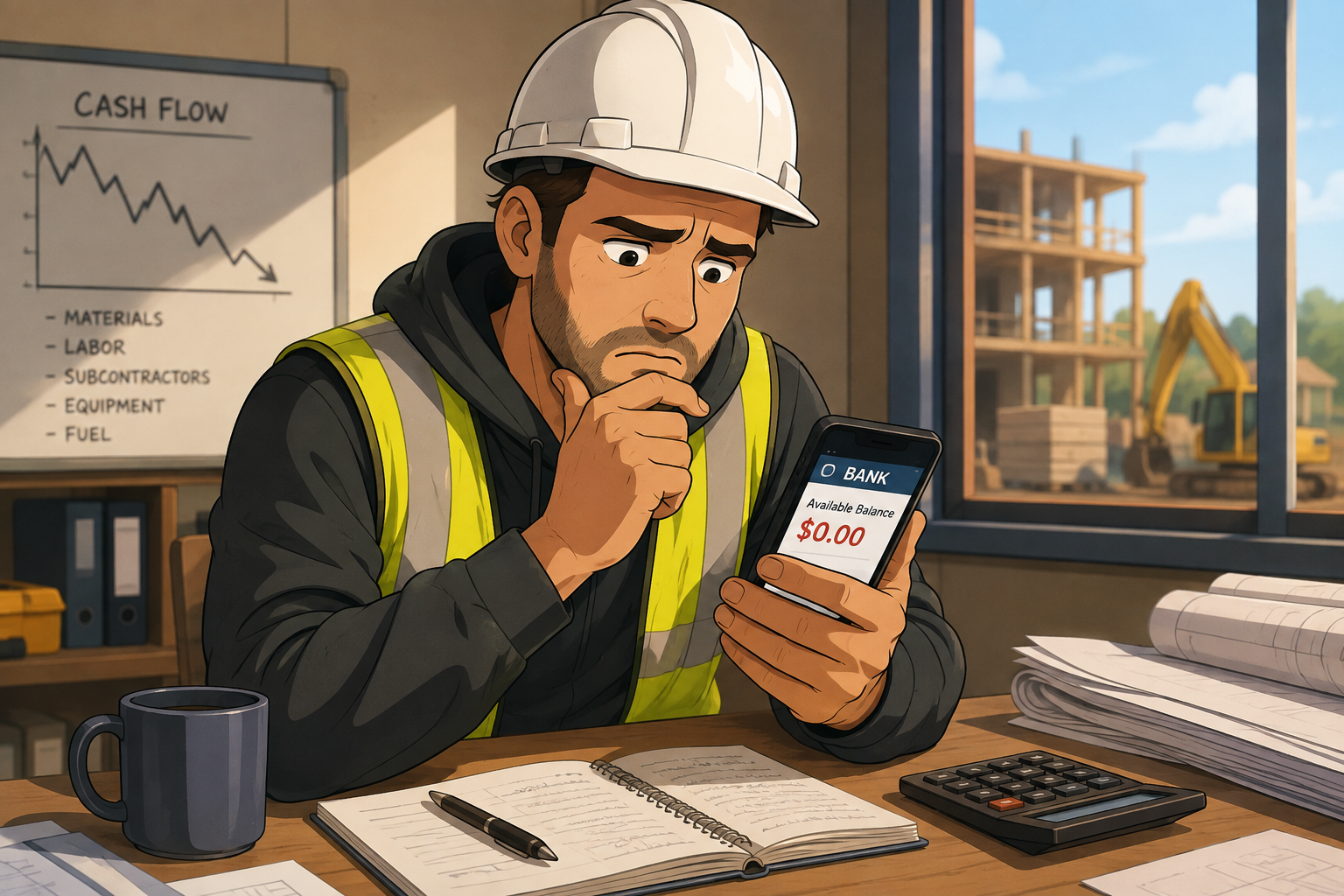
Your construction company made a healthy profit last year. Your income statement looks good. Your accountant tells you the business is profitable.
So why does it feel like there’s never enough money in the bank?
This is one of the most common sources of confusion for construction business owners. The answer is usually that profit and cash flow are not the same thing.
A construction company can report a strong net income while its cash is tied up in accounts receivable, holdbacks, work in progress, equipment purchases, debt repayments, or simply funding the next project.
Understanding where the cash went is one of the most important steps toward building a financially stronger construction business.
Profit and Cash Flow Are Not the Same Thing
Your income statement measures whether your company generated a profit over a period of time.
Your bank account measures something completely different: how much cash you have available right now.
For example, your company might complete $100,000 of work and recognize the related revenue.
But if the customer hasn’t paid the invoice yet, you don’t have another $100,000 sitting in the bank.
You have an account receivable.
The profit may already appear on your income statement, while the cash doesn’t arrive until weeks or months later.
Construction businesses can experience particularly large differences between profit and cash because of the way projects are billed, collected and funded.
1. Your Customers Haven’t Paid You Yet
Accounts receivable is one of the first places I would look when a construction company’s profit is increasing but its bank balance isn’t.
Suppose you invoice a customer $100,000 near the end of the month.
That revenue may contribute to your accounting profit.
But if the customer doesn’t pay for another 45 days, the cash hasn’t arrived.
Now imagine this happening across several projects.
Your income statement could show strong revenue and profitability while hundreds of thousands of dollars remain outstanding from customers.
Meanwhile, you still need cash to pay:
- Employees
- Subcontractors
- Suppliers
- Rent
- Insurance
- Equipment costs
- Taxes
- Other operating expenses
This creates a very common construction cash-flow problem:
You may effectively be financing your customers while paying your own expenses today.
2. Cash Is Tied Up in Construction Holdbacks
Holdbacks can make the difference between reported profit and available cash even larger.
On many construction projects, a portion of the amount you’ve earned may be held back rather than paid immediately.
That means your financial statements can reflect revenue and profit associated with work you’ve performed while a portion of the related cash remains unavailable.
Across one project, the amount might be manageable.
Across several large projects simultaneously, holdbacks can represent a significant amount of cash.
For example, imagine your company has several active projects and a combined $150,000 of receivables and holdbacks outstanding.
Your business may be profitable on paper, but that $150,000 isn’t available in the bank to fund payroll, suppliers or the next project.
This is why construction companies should monitor receivables and holdbacks separately from profitability.
3. You’re Using Cash to Fund Work in Progress
Another major issue is the timing between when you spend money on a project and when you’re able to bill and collect from the customer.
You may have already paid for:
- Materials
- Labour
- Subcontractors
- Equipment rentals
- Permits
- Site costs
But depending on your billing cycle, you may not have billed the customer yet.
Or perhaps you’ve billed them but haven’t collected the money.
Either way, your company is using its own cash to finance the project.
The faster your company grows, the bigger this problem can become.
Ironically, rapid growth can create a cash shortage even when the company is profitable.
You win more projects, hire more people, purchase more materials and engage more subcontractors.
All of those activities require cash before you necessarily collect from the customer.
4. You Bought Equipment
Equipment purchases are another reason your bank balance may fall without your income statement showing an equivalent expense.
Suppose your construction company purchases a piece of equipment for $60,000 cash.
Your bank account immediately falls by $60,000.
But depending on the nature of the purchase and applicable accounting and tax treatment, you generally don’t simply record the entire $60,000 as an ordinary operating expense on the income statement that day.
The equipment may instead be recorded as an asset and expensed over time through depreciation for accounting purposes.
Tax treatment can also differ from accounting treatment.
The important cash-flow point is simple:
$60,000 left the bank even though your current-period net income may not fall by $60,000.
So a profitable business can still experience a substantial reduction in cash after investing in equipment.
5. You’re Repaying Debt
Debt repayments create another important difference between profit and cash.
Suppose your company makes a $5,000 loan payment.
Part of that payment may represent interest, and part may represent repayment of the loan principal.
The interest portion generally affects your income statement.
The principal repayment reduces what you owe on the balance sheet.
But the entire $5,000 leaves your bank account.
If you’re making significant equipment, vehicle, acquisition or other loan payments every month, the effect on cash flow can be substantial even though those principal repayments aren’t ordinary expenses on your income statement.
6. You’ve Taken Money Out of the Company
Sometimes the explanation is much simpler.
The company earned money — and then the owners withdrew some of it.
Depending on how you’ve structured your compensation and withdrawals, cash may leave the corporation through things such as:
- Salary
- Dividends
- Shareholder advances
- Reimbursements
- Other payments to shareholders
Not every dollar leaving the company appears as an expense on the income statement.
Dividends, for example, aren’t an expense in determining the corporation’s accounting net income.
So a company could report:
$200,000 of net income
and then distribute a significant amount of cash to its shareholders.
The business was still profitable.
The cash simply isn’t in the corporation anymore.
A Simple Example: $200,000 of Profit, But Only $10,000 More Cash
Let’s put all of this together.
Suppose your construction company reports:
Net income: $200,000
At first glance, you might expect the company’s bank account to have increased by approximately $200,000.
But during the same year:
| Where the cash went | Amount |
|---|---|
| Net income | +$200,000 |
| Increase in receivables and holdbacks | -$70,000 |
| Equipment purchases | -$50,000 |
| Loan principal repayments | -$30,000 |
| Owner distributions | -$40,000 |
| Approximate increase in cash | +$10,000 |
The company made $200,000.
But its cash only increased by approximately $10,000.
Nothing necessarily disappeared.
The cash simply went somewhere other than the bank account.
And that’s why looking only at your income statement doesn’t tell you the whole story.
7. Growth Itself Can Consume Cash
This is particularly important for growing construction companies.
Imagine you’ve just won three major projects.
That’s great for revenue.
But those projects may require you to immediately increase:
- Payroll
- Materials
- Subcontractor payments
- Equipment
- Insurance
- Project management resources
- Working capital
You could therefore have your best sales year ever and simultaneously experience one of your tightest cash-flow periods.
This is sometimes referred to as overtrading — growing faster than the company’s working capital can comfortably support.
Growth isn’t necessarily the problem.
The problem is growing without understanding how much cash the additional work requires.
Your Bank Balance Doesn’t Tell You Whether You’re Profitable Either
There’s an important flip side to this.
Just because there’s plenty of cash in your bank account doesn’t necessarily mean the business is performing well.
Some of that cash could represent:
- GST/HST you’ve collected
- Payroll remittances
- Corporate income taxes
- Supplier bills that haven’t been paid
- Subcontractor amounts owing
- Customer deposits
- Loan proceeds
- A line of credit
A contractor might look at a $250,000 bank balance and feel extremely comfortable.
But if $180,000 of that cash is effectively committed to taxes, suppliers, subcontractors and other liabilities, the company’s true available working capital is much lower.
That’s why managing a construction company by checking the bank balance alone can be misleading.
What Should a Construction Company Monitor Instead?
Rather than asking only:
“How much money is in the bank?”
I’d want a construction business owner to understand several numbers together.
Net Income
Is the company actually profitable?
Gross Profit
Are your projects generating enough margin before overhead?
Accounts Receivable
How much have you invoiced but not yet collected?
Holdbacks
How much cash has been earned but remains held back?
Accounts Payable
How much do you currently owe suppliers and subcontractors?
Work in Progress
How much work and cost is sitting in active projects, and is your accounting properly reflecting the economic progress of those jobs?
Debt
How much cash is required every month for principal and interest payments?
Working Capital
Does the business have enough short-term financial capacity to fund its current operations?
Cash Flow
Most importantly:
Where did the cash actually come from, and where did it go?
Looking at these numbers together provides a much better picture than simply checking net income or the bank account.
Job Profitability Matters Too
There’s another question construction companies need to ask:
Which projects are actually making money?
A profitable company overall can still have individual projects losing money.
For example, one project might generate an excellent margin while another suffers from:
- Labour overruns
- Material cost increases
- Underpriced change orders
- Poor estimating
- Rework
- Scheduling problems
- Subcontractor overruns
- Scope creep
If you’re only reviewing the company-wide income statement, those problems can remain hidden.
That’s why job costing becomes increasingly important as a construction company grows.
You want to understand not just:
“Did the company make money?”
but:
“Which jobs made money, which didn’t, and why?”
The Real Question Isn’t “Where Did My Profit Go?”
A better question is:
“Where did my cash go?”
Those are two very different questions.
If your company reports $200,000 of profit, that profit didn’t necessarily vanish because the bank account didn’t increase by $200,000.
The answer may be sitting on your balance sheet.
It could be:
Accounts receivable.
Holdbacks.
Equipment.
Inventory or work in progress.
Debt reduction.
Or the cash may have been distributed to the owners.
Once you understand the relationship between your income statement, balance sheet and cash flow, the numbers start making considerably more sense.
Frequently Asked Questions
How can my construction company be profitable but have no cash?
Profit and cash flow measure different things. Cash may be tied up in receivables, holdbacks or work in progress, or it may have been used for equipment purchases, debt repayments, taxes or shareholder distributions.
Do accounts receivable count as profit?
Revenue recognition and cash collection don’t necessarily happen at the same time. Depending on the accounting circumstances, revenue may be recognized before the customer has actually paid you, creating an account receivable.
Why does growing my construction company make cash flow worse?
Growth often requires you to pay employees, suppliers and subcontractors before you’ve collected from customers. The faster the company grows, the more working capital it may require.
Does buying equipment reduce my profit?
Equipment purchases are generally capitalized rather than immediately treated entirely as an operating expense for accounting purposes. The cash can leave your bank immediately while the expense is recognized differently over time.
What financial reports should a contractor review?
At minimum, construction business owners should understand their income statement and balance sheet. Depending on the business, accounts receivable, accounts payable, holdbacks, cash flow, work in progress and job profitability reporting can also be extremely valuable.
Final Thoughts
If your construction company is profitable but there’s never enough money in the bank, don’t automatically assume something is wrong with the profit figure.
Start by finding out where the cash went.
Look at your receivables.
Look at your holdbacks.
Look at work in progress.
Look at equipment purchases.
Look at debt repayments.
Look at shareholder withdrawals.
And look at how much working capital is being consumed by growth.
Once you understand those movements, you can start managing profitability and cash flow together rather than treating them as the same thing.
Rocket Accounting works with construction and trades businesses on bookkeeping, corporate tax, financial reporting and understanding the numbers behind their businesses.
If your company is growing but you’re struggling to understand why that growth isn’t translating into cash, we can help you get a clearer picture.